Loading critic reviews...
Finding live streams...
About Assassin's Creed: Director's Cut Edition
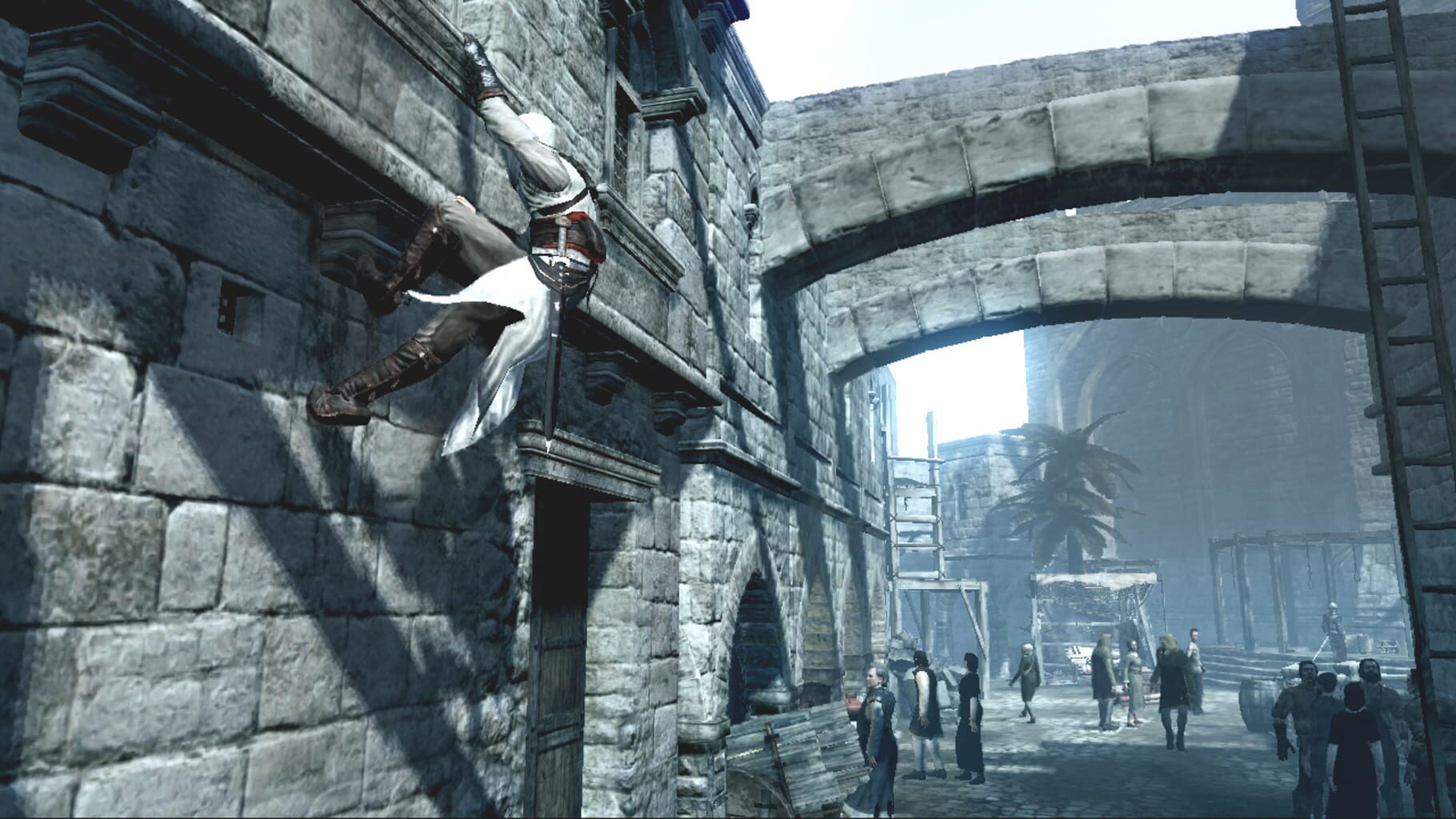
Assassin's Creed: Director's Cut Edition dropped in April 2008 from Ubisoft Montreal for PC. This adventure platformer frames a modern bartender named Desmond Miles inside the Animus to relive the genetic memories of his ancestor, Altaïr Ibn-La'Ahad. Altaïr serves as a Levantine Assassin during the Third Crusade in 1191. The Director's Cut adds four exclusive missions unavailable on other platforms, including rooftop races and stealth archery challenges. You control Altaïr across Jerusalem, Acre, and Damascus while navigating Templar plots involving ancient artifacts called Pieces of Eden. The narrative weaves between the historical setting and Desmond's struggle within a modern Abstergo facility. It remains a single-player experience focused on parkour movement and assassination mechanics.
Gameplay
You spend most of your time scaling towers, leaping across rooftops, and blending into crowds to approach targets. The core loop involves identifying nine key figures hiding in the Holy Land while maintaining a low profile. You can use hidden blades, thrown blades, or poison darts to eliminate these men without raising alarms. A health bar and an eagle vision ability help you track enemies and identify civilians versus combatants. The game features open areas where you can approach objectives from multiple angles. Parkour controls feel responsive as you run up walls or slide under barriers. The Director's Cut adds specific challenge modes that test your speed and precision in timed scenarios. You must manage stealth meters carefully since being spotted triggers a chase sequence with guards.
What Players Think
Players on PlayPile have logged an average of 18 hours per playthrough for this title. Critics and users alike gave it a solid score of 75.2 out of 100 based on 79 ratings on IGDB. The community mood leans heavily toward nostalgic appreciation, with many noting the game as a genre pioneer despite its age. Completion rates sit around 64% for those who started the campaign. Review snippets frequently mention the clever parkour system and the historical setting as major positives. Some users critique the repetitive nature of the assassination missions after the first few hours. Achievement data shows that mastering all four Director's Cut challenges remains a rare feat, completed by less than 12% of active players.
PlayPile's Take
This game is worth playing if you enjoy historical settings and want to see where modern stealth games began. The price on secondary markets is often low since it launched in 2008. You will find 30 achievements, though some require beating the new PC-exclusive content. The combat can feel clunky compared to modern standards, but the atmosphere holds up well. Do not expect a polished open world by today's metrics. It stands as a foundational piece for the series rather than a perfect entry point for new fans. Grab it if you want to understand the roots of the franchise.
Storyline
Desmond Miles, a bartender, is kidnapped by the company Abstergo Industries for use as a test subject in the "Animus," a device that can simulate genetic memory. Abstergo intends to put Desmond in the device to recall the memories of his ancestor, Altaïr Ibn-La'Ahad, a member of the Assassin Brotherhood in the year 1191, who lived during the Third Crusade in the Holy Land. Initially, Desmond has trouble adjusting to the device, but eventually relives Altaïr's exploits over the next several days. The game then primarily changes to Altaïr's point-of-view, with occasional transitions to Desmond, due to problems with the Animus or onset of the Bleeding Effect. The game opens with Desmond entering Altaïr's memory, but he soon faces synchronization problems. On this, Lucy Stillman and Warren Vidic's voices can be heard, arguing over Desmond's safety within the Animus. After experiencing a few problems, Desmond exits the virtual machine and Vidic briefs him about the Animus' inner workings, before initializing the machine's tutorial program. After Desmond is done with the tutorial, he enters the closest synchronizable memory of Altaïr; Lucy adds that Desmond has to relive key moments of Altaïr's life to increase his synchronization, before reaching the final memory which holds the information that Abstergo is seeking. Altaïr is first shown attempting to retrieve one of a series of artifacts known as the "Pieces of Eden" from Solomon's Temple with the help of Malik Al-Sayf, and his brother Kadar, but they are stopped by Robert de Sablé, Grand Master of the Knights Templar and sworn enemy of the Assassins. While retrieving the treasure, Altaïr breaks all three tenets of the Assassins' Creed in an attempt to kill Robert, but he ultimately fails. In the following commotion, Malik's brother is killed, and Malik's left arm is crippled and later amputated. When Altaïr returns to the Assassins' stronghold at Masyaf with apologies, Malik, who survived de Sablé, comes back with the artifact and disparages Altaïr because of his arrogance. After narrowly defeating a retaliatory attack by the Templars, Al Mualim, leader of the Assassins, demotes Altaïr to a novice but gives him another chance to rise through the ranks of the Brotherhood. Al Mualim assigns Altaïr the task of assassinating nine key figures across the Holy Land in Jerusalem, Acre and Damascus, aiming to bring peace between the Crusader and Saracen forces. Each target is based on an actual historical figure from the Third Crusade, including Majd Addin, Garnier de Naplouse, Jubair al Hakim, Abu'l Nuqoud, Sibrand, William of Montferrat, and Robert de Sablé. Altaïr completes each task, learning how each target is connected to Robert and the Templars and how together they aim to end the Crusades and place the Holy Land under their own control. With men on both sides killed, he discovers that Robert's last plot is to attempt to unite the Christian and Muslim forces against their new common enemy, the Assassins themselves. Altaïr defeats de Sablé before Richard the Lionheart, failing to convince the King that an end to the war would be welcome to both sides, but ending Robert's plot. From de Sablé, Altaïr discovers that Al Mualim was himself a member of the Templars and used the Assassin to kill the other members who held the secret to the treasure's power, so that he could selfishly keep the artifact for himself. Altaïr quickly returns to Masyaf and approaches his master, who reveals the truth to him: the Piece of Eden, which he had recovered through the help of Altaïr directly before his transgression, creates illusions. He denounces religion and other seemingly supernatural events (e.g. the Ten Plagues of Egypt, the parting of the Red Sea, and the presence of the Greek Gods in the Trojan War) as illusions caused by the Piece, and then states his intention to use the artifact to compel mankind into a brainwashed state, and in doing so, bringing an end to all conflict; Altaïr is eventually able to see through the deceptions created by the artifact to kill Al Mualim. When Altaïr recovers the artifact, the Piece of Eden activates, showing a holographic view of the world with numerous locations of other Pieces of Eden marked across the globe. When the process is complete, Desmond learns that Abstergo is a modern-day front of the Templars, and they are already seeking other artifacts at locations identified in Altaïr's memories. Further, he learns that the modern-day Assassins had tried to rescue him before the memory had completed but had failed. Following this, Desmond was to be killed after an order from a high-ranking Templar, Alan Rikkin, but Lucy Stillman saves him from death and, at one point, tucks her ring finger into her palm, referring to the Assassins' tradition of cutting off the finger. Though Desmond remains trapped in the Abstergo laboratory, his experience in the Animus has created a Bleeding Effect of Altaïr's life in his own, allowing Desmond to use Altaïr's Eagle Vision, which, in turn, allows him to see strange messages painted on the walls of his room and the floor of the lab. The messages all deal with various forms of the end of the world from different cultures, including several references to 21 December 2012, the date that Abstergo plans to launch a satellite that will "permanently end the war." It is hinted that this method would be by the same method that Al Mualim hypnotized Masyaf, only on a larger scale. Finally, the game ends with Desmond wondering what the images all mean and who could have drawn them.
Game Modes
Single player
IGDB Rating
75.2
Deals
Finding deals...
Videos
1Screenshots
10Achievements
Loading achievements...
Similar Games
Finding similar games...
Buzzing on Bluesky
Checking Bluesky...