Dawn of Discovery
IGDB
Players
Loading critic reviews...
Finding live streams...
About Dawn of Discovery
Dawn of Discovery drops you into a medieval world where building cities and managing trade take center stage. Developed by Related Designs and published by Ubisoft back in June 2009, this title blends city-building with real-time strategy mechanics. It launched on PC and serves as a spiritual successor to the Anno series, though it carries its own identity. The story frames your empire building around historical events like the Crusades and the rise of Hanseatic merchants. You start with a small fief and must expand your influence while navigating political intrigue involving emperors, cardinals, and sultans. It is a simulation game that demands you manage resources carefully to survive in a world driven by economics and warfare.
Gameplay
Your day-to-day involves constructing buildings, assigning workers, and balancing supply chains across different eras of technology. You begin by gathering basic materials like wood and stone to build simple houses for your population. As demand grows, you unlock advanced goods such as silk and porcelain through long-distance trade routes or local production. The campaign mode introduces these systems gradually while following a narrative where you help characters defeat corsairs and stop conspiracies. You control units in real-time during battles, but most of your time is spent tweaking production chains to keep citizens happy. Multiplayer lets you face off against computer opponents like Lord Northburgh or Al Zahir, who act as trade partners or rivals depending on the scenario settings.
What Players Think
Players and critics have given this title a solid reception with an average score of 76.1 out of 100 based on 151 ratings on IGDB. The community notes that the campaign serves as an effective tutorial, often leading to high completion rates among those who finish the eight chapters. Average playtime sits around forty hours for a full campaign run on medium difficulty, with harder settings extending that significantly. Reviews frequently highlight the depth of the economic systems and the historical setting as major strengths. Some users mention frustration with AI pathfinding during large battles, yet the trade mechanics remain a favorite aspect. The mood in discussions is generally positive, focusing on the satisfaction of seeing a small village grow into a bustling metropolis connected by complex shipping lanes.
PlayPile's Take
This game is for players who enjoy deep economic simulations and do not mind slow-paced strategy over fast reflexes. You will spend more time staring at resource numbers than managing armies. The price point on secondary markets remains low, making it an easy buy if you can find a copy. Achievements are tied to campaign progression and specific trade milestones rather than obscure challenges. If you want a game where every decision impacts your supply chain, this fits the bill. Skip it if you expect constant combat or modern graphics. It is a solid simulation that stands on its own merits despite its age.
Storyline
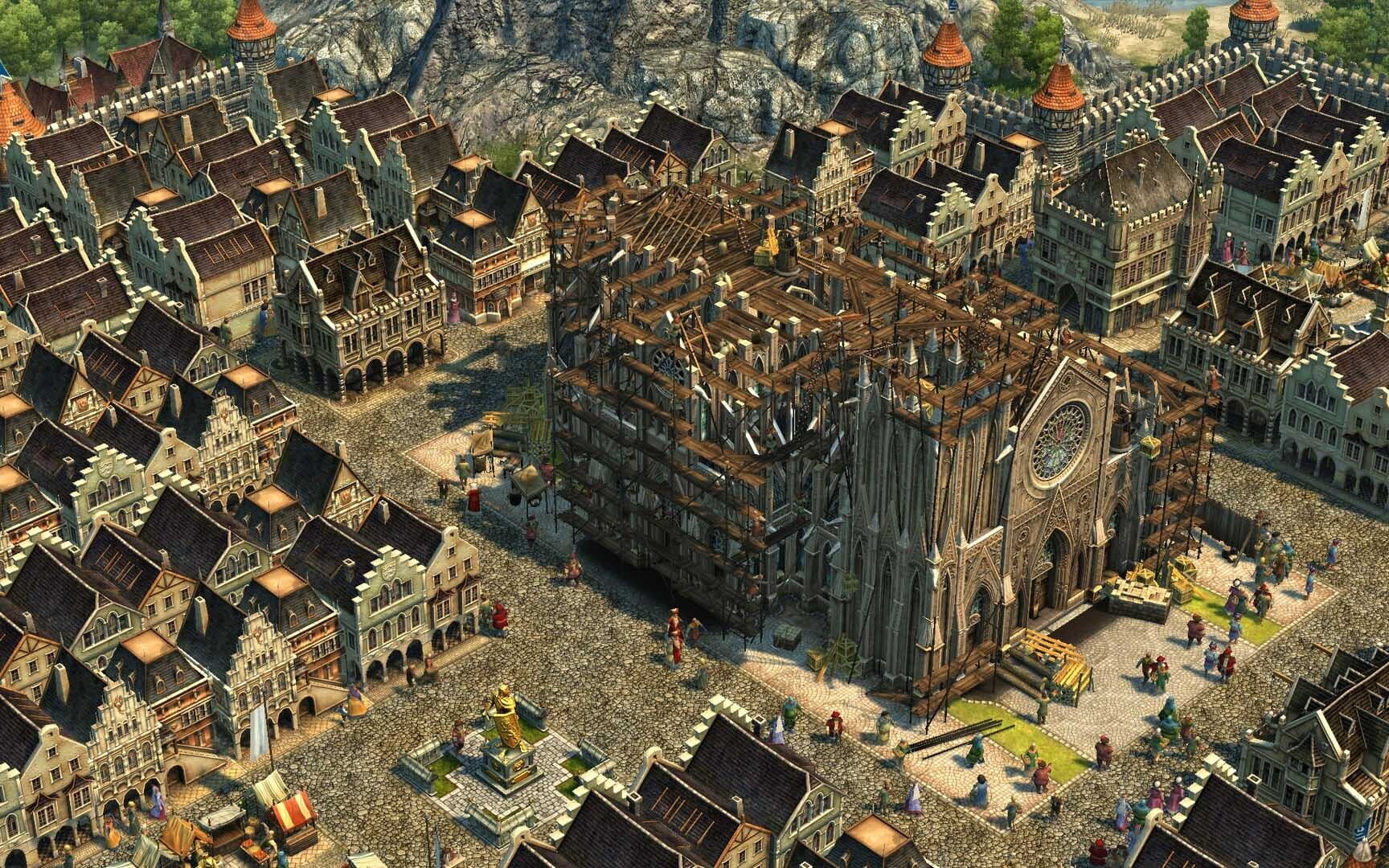
The campaign begins when the player is sent to administer a fief granted to him by the Emperor, in the Occident. The Emperor is unwell and Lord Richard Northburgh, cousin and treasurer of the Emperor, is building a magnificent Cathedral to pray for the Emperor's health. Meanwhile, Cardinal Lucius is making preparations for a Crusade against the Saracens of the Orient, aided by Guy Forcas. In the first few chapters of the campaign, the player learns the basics of game-play and the economy by assisting Northburgh and Forcas with supply and construction tasks, as well as meeting some of the other main characters. As the Crusader ships leave the harbour, Northburgh begins to uncover clues to a mysterious plot. He and the player travel to the Orient and befriend the Grand Vizier of the Sultan, Al Zahir, who helps the player to defeat a band of Corsairs and break up a child trafficking scheme. The plot thickens as further clues reveal that a main character is implicated in a sinister conspiracy to overthrow the Emperor himself. Because he comes too close to the truth, Lord Northburgh is captured and the player is tasked with unravelling the mystery. Over the next several chapters, the player must win over new allies, convince the leaders of the Crusade that they are being manipulated under false pretenses, and survive dire circumstances in order to defeat the villains and restore the Emperor to his rightful place. The campaign is divided into eight chapters and each chapter can be played on 3 different difficulties: easy, medium, and hard. Apart from the story elements, the campaign serves as a tutorial to prepare the player for the more rigorous scenarios and continuous game modes. All of the main characters encountered in the campaign are also encountered in the scenarios mode and can be selected as computer opponents in continuous games, although the actions of the characters during the campaign are unrelated to their actions in these modes apart from having similar personalities. Lord Northburgh and Al Zahir act as mentors and trade partners in the other modes, much like they do in the campaign.
Game Modes
Single player, Multiplayer
IGDB Rating
76.1
Deals
Finding deals...
Videos
1Screenshots
10Community Moods
Achievements
Loading achievements...
Similar Games
Finding similar games...
Buzzing on Bluesky
Checking Bluesky...