Best Programming Games That Actually Teach You to Think Like a Coder
From terminal hacking to circuit design, these games turn programming into genuinely compelling puzzles.
March 16, 2026 · 5 min read
Mom of two, gamer for life. I find the best games you can actually finish between school runs and bedtime stories.
Programming games shouldn't work as entertainment. They ask you to write actual code, debug logic errors, and optimize solutions against arbitrary constraints. Yet somehow, a dedicated subset of developers has turned these mechanics into genuinely compelling experiences. If you've ever wondered what it feels like to hack into a system, design circuits, or write assembly code for fictional machines, these games deliver that fantasy without requiring a computer science degree.
The Hacking Fantasy
Uplink
Introversion Software essentially invented the hacking game genre back in 2001. You play as a hacker for hire, accepting contracts through a sleek retro-futuristic interface. Jobs range from simple data theft to framing innocent people for crimes they didn't commit. The tension comes from covering your tracks: bouncing connections through compromised servers, wiping logs before traces catch up, and disconnecting before federal agents pinpoint your location.
What makes Uplink special is how it simulates the feeling of hacking rather than the reality. You're not writing actual exploits. You're clicking through interfaces, timing your actions against countermeasures, and making split-second decisions about risk versus reward. The aesthetic is pure 90s cyberpunk, and it holds up remarkably well.
Hacknet
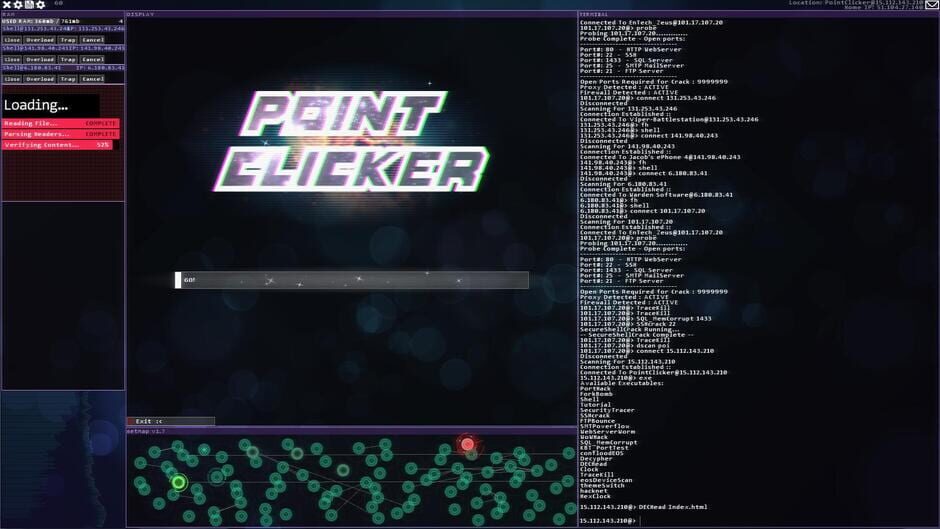
Where Uplink abstracts hacking into mouse clicks, Hacknet puts you in an actual terminal. You type real Unix-style commands: scan, probe, sshcrack, connect. The game teaches you these commands naturally through its narrative about investigating a dead hacker's final message. Something about typing commands into a blinking cursor hits differently than clicking buttons.
Hacknet's strength is atmosphere. The electronic soundtrack pulses as you break into systems. Deadlines create genuine tension. And the puzzles require actual problem-solving: finding passwords in emails, chaining exploits together, and navigating file systems. It's accessible enough for newcomers but rewards players who engage with its systems deeply.
The Zachtronics Catalog
Zachtronics deserves its own section. No other studio has committed so thoroughly to making programming puzzles into art. Every release follows the same formula: here's a fictional system, here are arbitrary constraints, optimize until your brain melts. They're brilliant.
TIS-100
The entry point for masochists. TIS-100 presents you with a manual for a fictional 1970s computer and asks you to program it in assembly language. Not fake assembly. Actual assembly: mov, add, jmp, conditional branches, register management. The interface is intentionally obtuse. The documentation is a PDF you're expected to print out and reference constantly.
And somehow it works. Each puzzle is a small miracle of optimization. Can you reduce your cycle count by reordering instructions? Can you parallelize across nodes? The leaderboards taunt you with solutions more elegant than anything you've managed. TIS-100 proves that constraints breed creativity.
Shenzhen I/O
This one asks you to design circuits for consumer electronics. You're an engineer at a Shenzhen company, building everything from animated signs to security systems. The gameplay splits between hardware design (placing components, wiring connections) and software (writing compact assembly for microcontrollers with brutally limited memory).
Shenzhen I/O refines everything Zachtronics learned from TIS-100. The puzzles feel more grounded because you're building recognizable products. The constraints make sense within the fiction. And the satisfaction of watching your circuit light up correctly never gets old. It even includes a fully playable solitaire variant as an in-game break.
Exapunks
The most stylish Zachtronics game wraps its programming puzzles in 90s zine aesthetics. You're a hacker dying from a mysterious phage, taking jobs to afford doses of the only medicine that keeps you alive. The vibe is pure cyberpunk: underground networks, corporate intrigue, and programs that feel like digital graffiti.
Mechanically, you write code for EXAs: small programs that can move through networks, read and write files, and communicate with each other. The twist is parallelism. Many puzzles require coordinating multiple EXAs, timing their actions, and handling edge cases when things collide. It's Zachtronics at their most accessible, though "accessible" here still means "will make you feel stupid regularly."
Opus Magnum
The outlier in the Zachtronics lineup, Opus Magnum replaces code with mechanical design. You build alchemical machines: arms that grab, pivot, and drop atoms to transmute base metals into gold, create healing salves, or forge magical weapons. No programming language here, just spatial reasoning and optimization.
It's also the most visually satisfying Zachtronics game. Watching your completed machine loop through its production cycle, arms dancing in patterns you designed, is genuinely mesmerizing. The game records GIFs of your solutions, and sharing them became a small subculture. If traditional programming games intimidate you, Opus Magnum offers the same satisfaction through a different lens.
Why These Games Work
The appeal isn't really about programming. It's about mastery. These games give you systems with clear rules and ask you to understand them completely. The feedback loop is immediate: your solution either works or it doesn't. There's no ambiguity, no hand-waving, no fudging the numbers. Just you and the problem.
They also scratch the same itch as puzzle games but with infinite replayability. Once you solve a Zachtronics puzzle, you can optimize it forever. Leaderboards track multiple metrics: speed, cost, lines of code. There's always a better solution out there.
If you've never tried this genre, start with Hacknet or Opus Magnum. They're the most forgiving introductions. Save TIS-100 for when you're ready to suffer productively. And if you finish everything here, know that the rabbit hole goes deeper. Much deeper.